Researcher at Stanford University

Vidur Gupta

I build networked systems that are fast and correct for every user. To me, a correct system is fair, secure, and private.

I work with Nirav Atre of Stanford and Anirudh Sivaraman of NYU on fair event ordering at low latency, and I have worked with Emma Dauterman and David Mazières on private authentication logging.

Before research, I spent nearly four years at Apple, where I designed software architecture for the first eSIM-only iPhone and Apple’s first in-house 5G modem.

LinkedIn GitHub

CV available upon request.

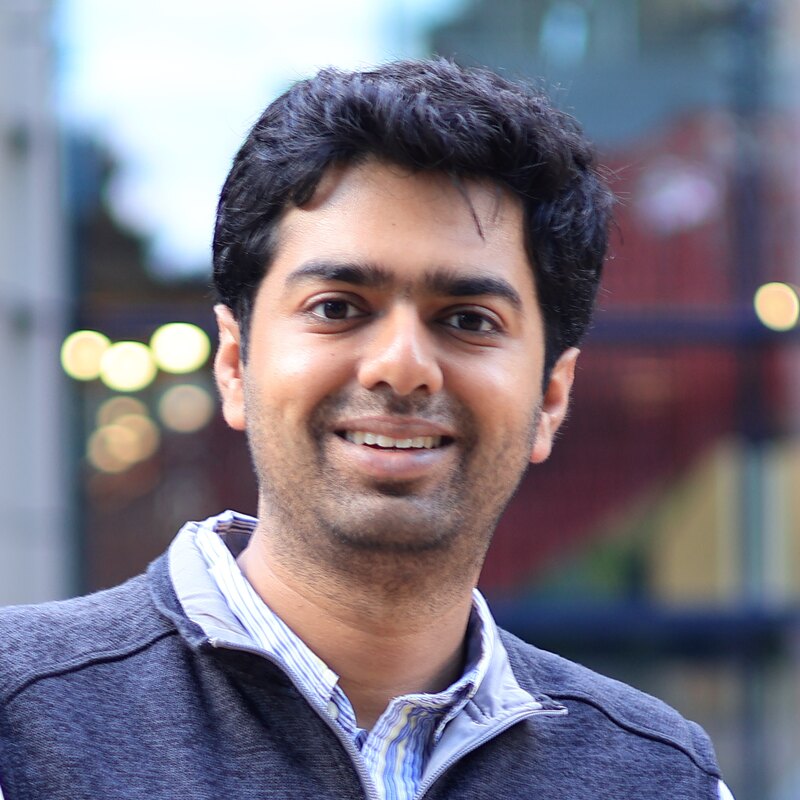
Portrait of Vidur Gupta
01

Research

I study how networked systems can make correct decisions quickly when their measurements are noisy. Two ideas guide this work.

Statistical optimality

Statistics in software correct noisy measurements, so that a system makes the fewest expected errors given its evidence.

Evidence aliasing

The limit of that correction, where two states of the world leave the same evidence.

Six events from three clocks arrive out of order, and the sequencer releases them in the order of their creation. clock Aclock Bclock C 1 4 2 5 3 6 sequencer 1 2 3 4 5 6 arrival is out of orderoutput follows creation order

Distributed systemsLow latency

Fair event ordering at low latency

2026 to present · with Nirav Atre (Stanford) and Anirudh Sivaraman (NYU)

Stock exchanges, ticket sales, and cell towers handing off calls all depend on the order of events. Arrival order favors the fastest network path, and timestamps are often unreliable, as every clock drifts. I build and measure sequencers on NTP-synchronized clocks, and I grade their ordering against PTP hardware timestamps.


Of 631,045 active SIP endpoints, all but four that require authentication use MD5 defaults, 87 percent omit the replay defense, and at least 76.6 percent of TLS endpoints also allow plaintext. 631,045active SIP endpoints MD5 Digest defaultsall but 4 no replay defense87% TLS that also allows plaintextat least 76.6%

SecurityMeasurement

A security census of Internet-facing voice infrastructure

2026 · single author · ACM IMC 2026

The first Internet-wide measurement of SIP security. I scanned the IPv4 space with ZMap and confirmed 631,045 active endpoints. All but four that require authentication use 25-year-old MD5 defaults, and at least 76.6% of SIP-over-TLS endpoints also allow plaintext.

A sender spreads five coded shares over five paths. Two paths fail, and the receiver rebuilds the block from the three shares that arrive. sendrecv any 3 of 5 shares rebuild the block

TransportQUIC

Striped Tunnels: reliable transport from unreliable paths

2026 · CS 244C project with C. Hernandez-Meza, S. Fisher, and A. Sriram

We built a layer beneath QUIC that erasure-codes each block into n shares across independent paths, so the receiver rebuilds it from the first k to arrive. In ns-3 emulation, coded QUIC reached up to 11 times the throughput of vanilla QUIC at 5% loss, while still sharing bandwidth fairly with competing TCP traffic.

Each login adds a verified row to a log, while the user and the website stay hidden. authentication log user hiddensite hidden

PrivacyCryptography

Private authentication logging

2025 to 2026 · with Emma Dauterman and David Mazières

I built the WebAuthn and authentication integration for a privacy-preserving authentication log, a system led by Ihyun Nam. The paper is under review.

A phone rides toward a tunnel. It stops scanning for a signal just before the coverage hole and resumes after it. tunnel coverage hole ahead scan paused

WirelessMachine learning

Predictive radio control for underground coverage holes

2025 · first author · IEEE ICMLCN 2026

A phone in a subway or tunnel wastes modem energy on scanning for a missing signal. I built a framework that predicts an imminent coverage hole from radio, GNSS, inertial, barometric, and transit-card signals, with a theoretical 40% modem energy reduction.

A user sends one opt-out signal to an agent, and the agent passes it on to every tool it calls. user agent tool agent site opt out opt out opt out opt out

PrivacyAI agents

Privacy preference controls for agentic systems

2026 to present · project led by Sebastian Zimmeck

The team is extending Global Privacy Control, the browser opt-out signal, to AI agents that act on behalf of users.

02

Path

  1. 2019 to 2021

    Purdue University

    BS in Computer Science

    I designed and taught CS 490, iOS Programming with Swift, as an undergraduate.

  2. 2022 to 2025

    Apple

    Research Software Engineer, Wireless Technologies

    I worked on the first eSIM-only iPhone and the C1, Apple’s first in-house 5G modem.

  3. 2023 to 2024

    Columbia Engineering

    MS in Computer Science

    I completed the degree while working full time at Apple.

  4. 2024 to now

    Stanford University

    MS in Electrical Engineering, now researcher

    I work on fair ordering, Internet measurement, secure systems, and privacy.

03

Publications

  1. IMC 2026

    Dialing in the Open: A Security Census of Internet-Facing Voice Infrastructure

    Vidur Gupta

    ACM Internet Measurement Conference, Karlsruhe, Germany

  2. ICMLCN 2026

    Predictive Radio Control for Energy-Efficient Operations in Underground Cellular Coverage Holes

    Vidur Gupta, S. H. H. Subramanya

    IEEE International Conference on Machine Learning for Communication and Networking, Abu Dhabi, UAE

  3. SemEval 2026

    CausalMinds at SemEval-2026 Task 12: Simple Fine-Tuning with Option Shuffling Outperforms Complex Pipelines for Abductive Event Reasoning

    Vidur Gupta, X. Zhao, J. Shaye

    SemEval Workshop at ACL 2026, San Diego, CA

  4. Preprint

    Privacy Preference Controls for Agentic Systems

    S. Kochar, P. Sugsavanvit, Vidur Gupta, J. A. Calandrino, D. Kumar, B. Frischmann, S. Zimmeck

    Submitted manuscript, arXiv:2610.29929

04

Patents

From 2022 to 2025, I was a Research Software Engineer in Apple’s Wireless Technologies division. I was a key engineer on the first eSIM-only iPhone 14, the C1 modem, and the converged eUICC and NFC secure element for Apple Watch, and I helped draft Apple’s proposals to GSMA and 3GPP. I filed seven patent applications, and six are public.

One more application is in the provisional phase.

05

Teaching

  • Research mentor

    Stanford University, 2025 to 2026

    I led two undergraduates on SemEval 2026 Task 12, from problem framing to an accepted workshop paper at ACL 2026.

  • Course Instructor

    Purdue University, Fall 2021

    I designed and taught CS 490, iOS Programming with Swift, as an undergraduate.

  • Teaching Assistant

    Purdue University, 2020 to 2021

    Systems Programming (CS 252), Computer Architecture (CS 250), and Software Engineering Tools (CS 193).

06

Service

  • Program Committee

    2027, incoming

    USENIX Conference on Privacy Engineering Practice and Respect (PEPR).

  • Technical Program Committee

    2026

    IEEE Symposium on Privacy Expectations (ISoPE).

Get in touch

I am glad to hear from researchers and students who work on networked systems, measurement, or privacy. My CV is available upon request.

LinkedIn GitHub